
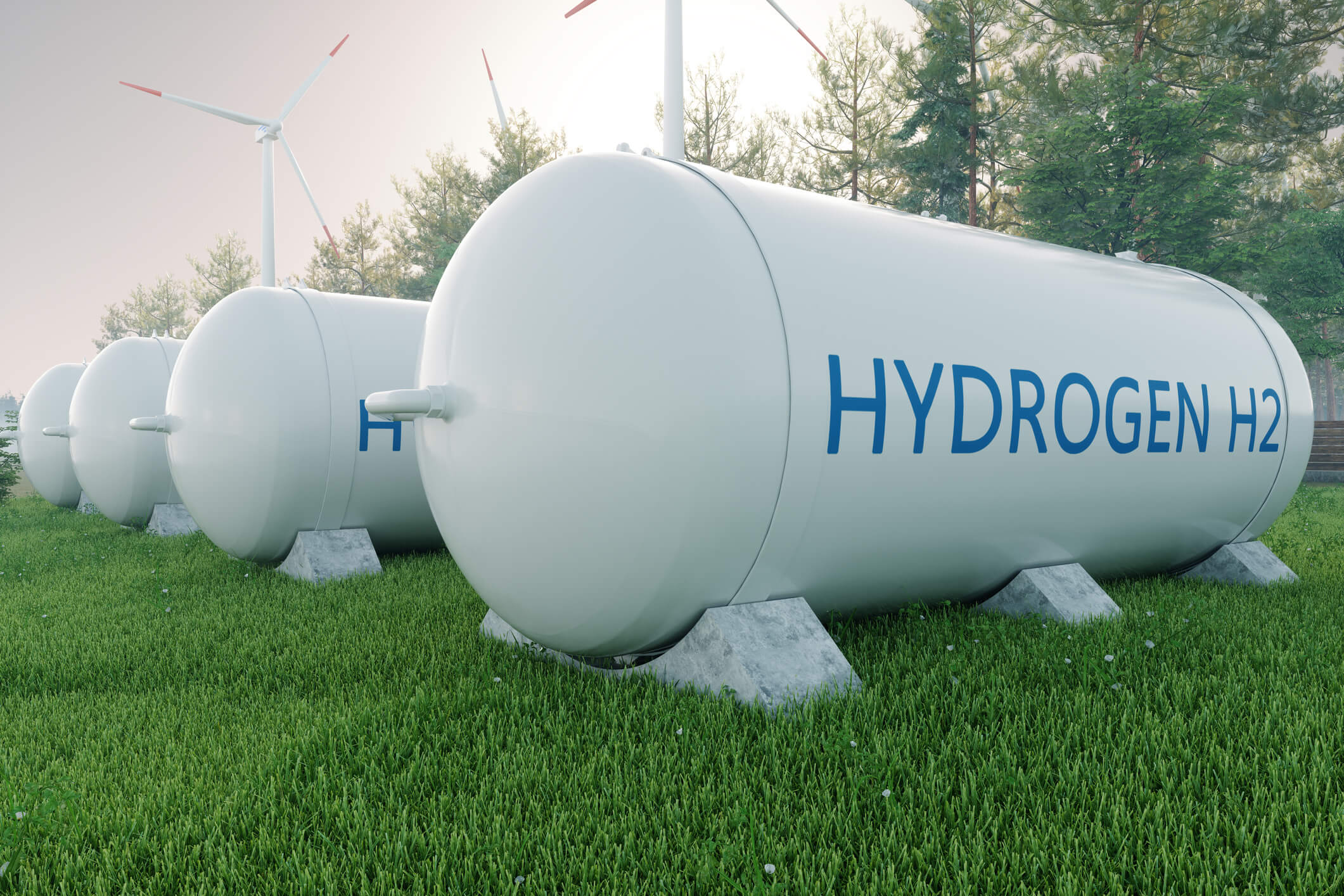
As the world moves towards adopting hydrogen as an energy carrier for a clean energy future, effective and safe hydrogen storage has become a critical challenge. Hydrogen has the highest energy per mass of any fuel but its low ambient temperature density results in a low energy per unit volume, requiring the development of advanced storage methods with potential for higher energy density. Hydrogen storage is thus a key enabling technology for the advancement of hydrogen and fuel cell technologies in applications including stationary power, portable power, and transportation.
How is Hydrogen stored?
There are multiple ways hydrogen is stored – as a compressed gas in high-pressure tanks, in geological structures, as a cryogenic liquid at extremely low temperatures, as metal hydrides, and in the form of certain chemicals.
Compressed Gas
This is the most common method today. Hydrogen gas is compressed up to 700 bar pressure in cylindrical steel and composite tanks. 4 types of tanks/cylinders are currently used:
- Type I cylinders are pressure vessels made of metal material. They are used to store H2 for industrial gas at pressures between 150-300 bar. These are the most widely used and cheapest high-pressure tanks, but too heavy for vehicle use.
- Type II cylinders have a thick metal liner wrapped with carbon or glass fibre. They can withstand pressures up to 1000 bar and are used in hydro generators as high-pressure tanks.
- Type III tanks have a metal liner to prevent hydrogen leakage, fully wrapped with composites to withstand mechanical stress. By using more composites instead of thick metal, they are lighter than Types I and II.
- Type IV cylinders are made of a polymer liner enclosed in carbon fibre. They can handle 350-700 bar pressure and are designed for portable applications where weight savings are essential. However, they are more expensive due to the carbon fibre.
Geological Storage
Salt caves, depleted natural gas and oil fields which are currently used to store natural gas, could be used for storing hydrogen. These underground storage possibilities allow for large-scale, long-term storage.

Oil and gas fields are usually larger than salt caves, but they are also more permeable and contain pollutants that would require removal before using the hydrogen in fuel cells. Water aquifers are the least mature among all options, and their suitability is still being discussed.
Liquid Hydrogen

Cooling hydrogen to extremely low temperatures (-253°C) condenses it to a liquid with higher density than gas. The liquefaction process employs a combination of compressors, heat exchangers and expansion valves to achieve the necessary cooling. This allows more hydrogen to fit in a tank but requires complex insulation to keep temperatures low. Around 30-40% of energy is lost in the process, however, a potential efficiency loss of only 12.79% can be achieved.
Metal hydrides
Hydrogen bonds with certain metals and metal alloys to form solid metal hydrides. These can store hydrogen at lower pressures. However, the absorption process takes considerable energy.
Chemical storage

Hydrogen can bind with other molecules like ammonia (NH3) or methanol (CH3OH). This results in higher energy-density fuels, but requires an additional process to extract pure hydrogen.
Why is it difficult to store Hydrogen?
Hydrogen possesses an intrinsic physical property that profoundly impacts its storage capabilities – it is an exceptionally lightweight gas. At standard temperature and pressure, hydrogen’s density is approximately one-eleventh that of air. This means that hydrogen occupies far more volume than other gases. Storing just one kilogram of pure hydrogen gas requires around 11 cubic meters. For context, this amount of hydrogen could fuel a vehicle to travel 100 kilometres.
Some more challenges associated with storing hydrogen
- Safety: Hydrogen can leak through many materials that are considered airtight or impermeable to other gases. It’s also buoyant, meaning it will rise quickly under atmospheric conditions and can accumulate at the ceiling. When mixed with air, hydrogen can result in flames or explosions.
- Embrittlement: Hydrogen embrittlement is a reduction in the ductility of a metal due to absorbed hydrogen. Hydrogen atoms are small and can permeate solid metals. Once absorbed, hydrogen lowers the stress required for cracks in the metal to initiate and propagate, resulting in embrittlement.
- Boil-off losses: Boil-off losses occur when liquid hydrogen (LH2) evaporates and gaseous hydrogen is released from a cryogenic tank. This is primarily due to heat leakage into the tank.
The Path Forward
While hydrogen storage poses some unique challenges due to the physical properties of hydrogen, ongoing research and development efforts are making steady progress. Advanced materials and engineering solutions are helping overcome technical barriers related to cost, weight, volume, efficiency and safety. Multiple storage techniques at different stages of maturity are being explored concurrently to enable diverse end-use cases. Scaled-up demonstration projects for geological storage, liquid hydrogen infrastructure, new composite tanks and other innovations will pave the way for widespread hydrogen deployment. With continued commitment from both public and private sectors, safe and effective hydrogen storage and transport can soon become a reality. This will prove foundational to building the clean energy economy of the future.