
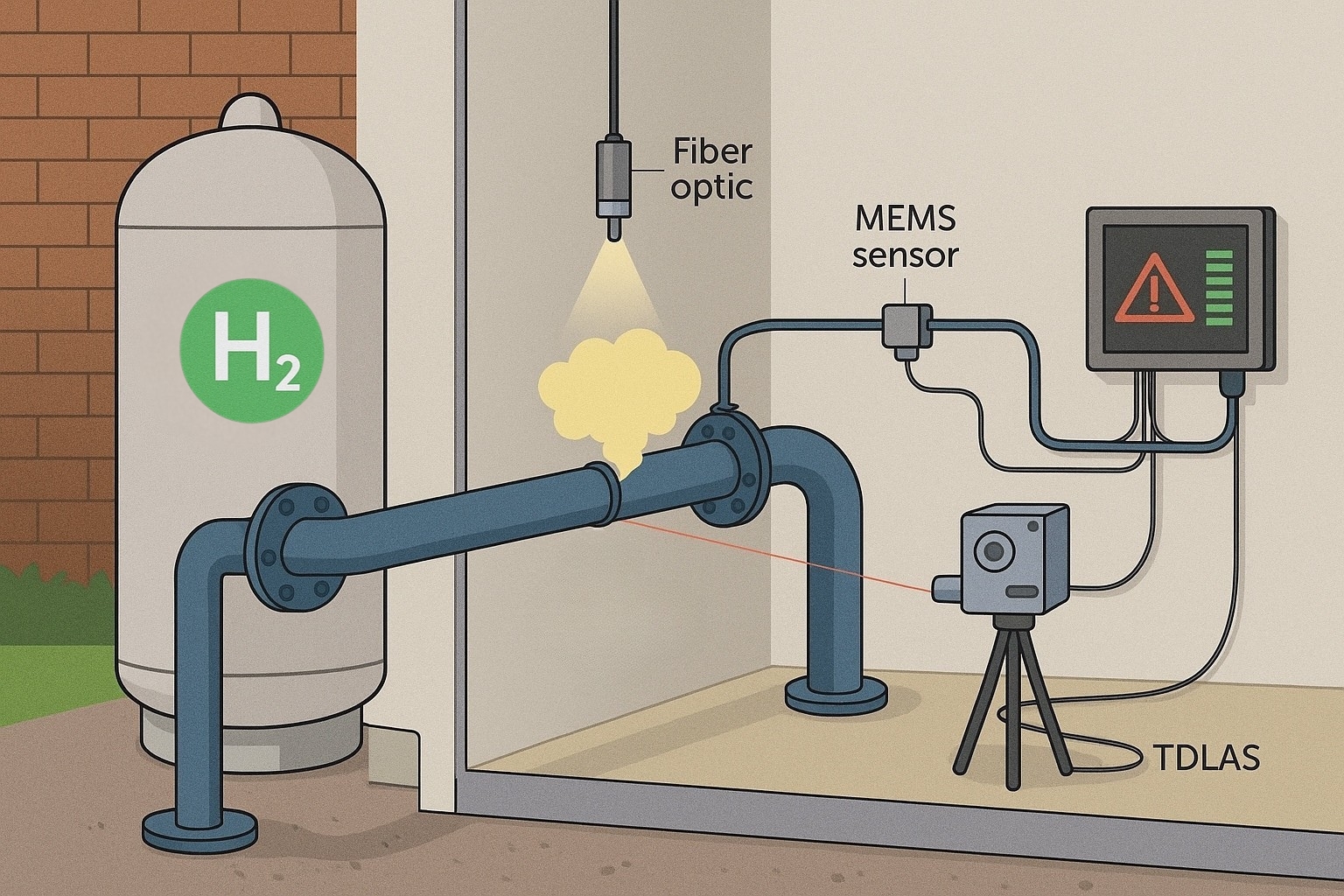
As hydrogen moves from niche to mainstream powering electrolysers, pipelines, mobility, and storage, the ability to detect even the smallest leaks isn’t just about safety. It’s about efficiency, purity, credibility, and cost.
But hydrogen isn’t like other gases.
Its unique properties like low molecular weight (~2 g/mol), high diffusivity (~0.61 cm²/s in air), low ignition energy (~0.017 mJ), and ultra-wide flammability range (4–75%) make it harder to detect, contain, and manage.
Conventional detection systems (IR hydrocarbon sensors, catalytic beads, fixed alarms) often fall short. Why?
- Hydrogen lacks strong IR absorption in the near-IR region, making traditional IR detectors ineffective without customization.
- Its vertical leak plume behaviour due to low density often requires non-traditional sensor placement, especially in ventilated spaces.
- Sub-ppm leaks may not pose a direct hazard but can impact purity and system efficiency in fuel cells and closed-loop electrolyser stacks.
Emerging Detection Technologies
1. TDLAS (Tunable Diode Laser Absorption Spectroscopy)
- Can be adapted for hydrogen using specialized mid-IR wavelengths
- Effective for pipeline and process vessel monitoring, though less commonly used than for CO, CH₄, or NH₃
2. Palladium-Based Sensors
- Pd films form hydrides upon H₂ exposure, altering electrical resistance
- Highly sensitive in cleanroom and controlled lab settings, but high cost and reversibility issues limit widespread field use
3. MEMS/CMOS Micro-Sensors
- Compact, low-power, fast response
- Ideal for embedded monitoring in fuel cell stacks, drones, or hydrogen storage modules
4. Fiber Optic-Based Detection
- Immune to electromagnetic interference
- Being explored for explosive and harsh environments, including subsea and tunnels, though still in pilot-stage deployment
Detection is just step one. Smart hydrogen infrastructure combines:
- CFD-based sensor placement (considering plume behavior)
- Integration with SCADA/DCS systems for remote shutoffs
- Predictive analytics from pressure decay and flow anomalies
- 3D dispersion modeling for indoor H₂ installations
In hydrogen infrastructure, containment = credibility.
Detection isn’t a checkbox. It’s a continuous, adaptive strategy tied to ESG reporting and insurance. If we’re building a hydrogen economy, let’s make sure it’s a safe, transparent, and technical one.