
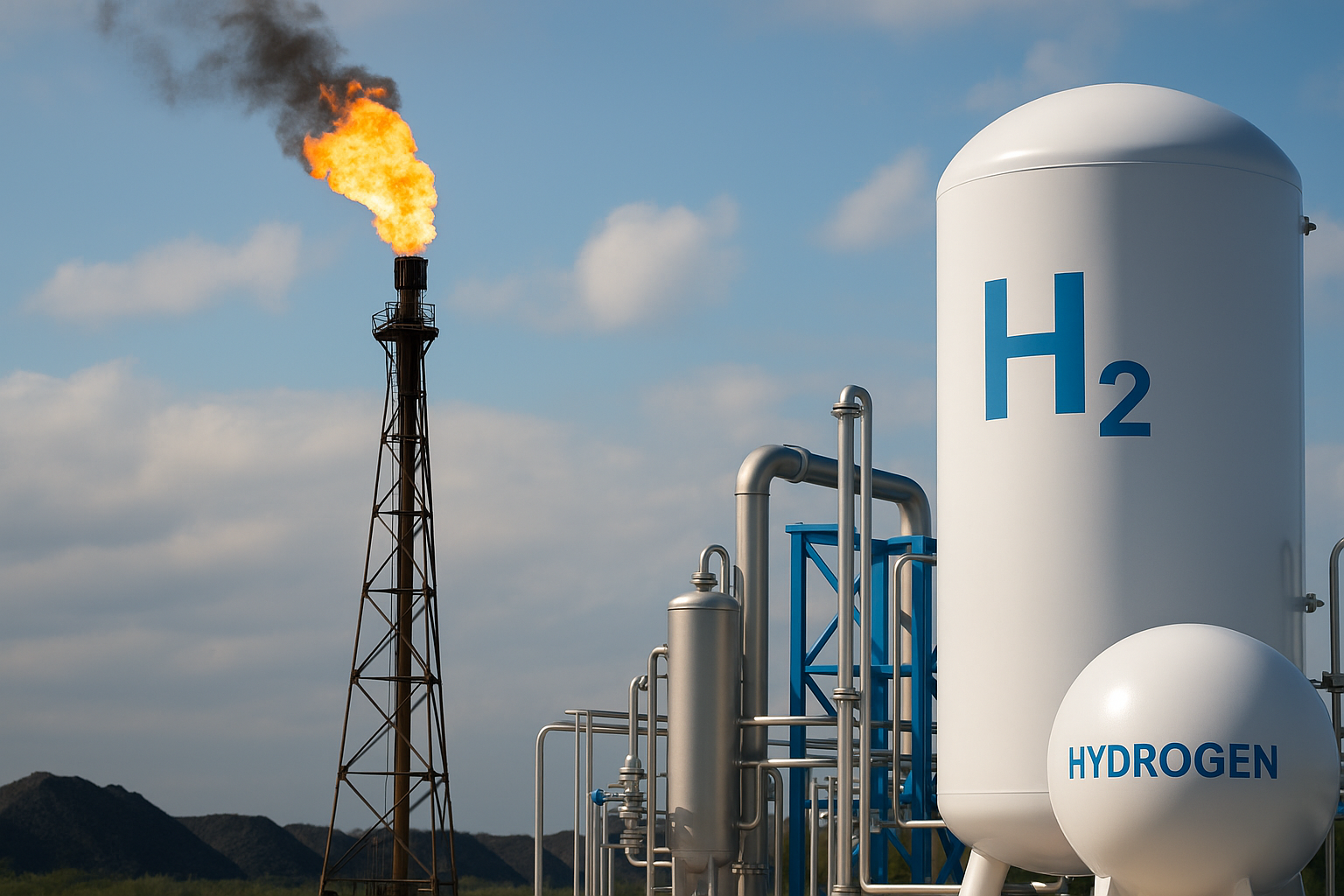
Natural gas has long powered our industries, offering reliability, high energy density, and lower emissions compared to coal. But with decarbonisation no longer optional, the landscape is changing fast. And Green Hydrogen is stepping up as a serious contender.
Let’s break this down.
The Cost Factor:
As of 2024, industrial natural gas in India costs about ₹70/kg, depending on contracts and location. Green Hydrogen, thanks to falling renewable costs, is now hovering around ₹335/kg as per the latest price discovery from IOCL’s 10KTPA result announcement.
At face value, it seems natural gas is significantly cheaper. But when we take the energy factor into account, the difference becomes meaningfully smaller.
Hydrogen delivers nearly 2.5 times more energy per kg than natural gas. This significantly alters the cost dynamics when evaluated on an energy-equivalent basis.
So, when you normalize costs based on actual energy delivered:
- Natural gas at ₹70/kg becomes about ₹175/kg of Hydrogen-equivalent energy.
- Green Hydrogen stands at ₹335/kg
While Green Hydrogen is still more expensive today, improving system efficiencies, declining electrolyser CAPEX, and falling renewable energy prices suggest it may soon compete head-on with natural gas — both economically and environmentally.
Emissions Profile:
This is where Green Hydrogen wins hands down.
Burning 1 kg of natural gas emits 2.75 kg of CO₂, not even counting upstream methane leaks, which are 80+ times more potent than CO₂ over 20 years.
Green Hydrogen, produced via electrolysis from renewables, emits minimum CO₂ during both production and use. That’s a total knockout in a world heading toward carbon taxes, net-zero mandates, and ESG reporting.
Green Hydrogen still has hurdles:
- Infrastructure isn’t plug-and-play. You need burner retrofits or new combustion tech.
- Hydrogen is harder to store and transport. Being the tiniest molecule makes it leak-prone.
- Electrolyser efficiency sits at around 70% today, but newer tech could soon push it above 90%.
Yet in sectors like steel, glass, ammonia, and high-temperature heat Green Hydrogen offers not just a cleaner molecule, but a long-term decarbonisation pathway.
Blending it with natural gas (10–20%) is already happening. And on-site generation using renewables skips pipeline hassles altogether.
Conclusion:
Green Hydrogen may not beat natural gas everywhere, today. But in many places, it already does on energy efficiency and environmental impact. The cost curve is bending. The infrastructure is catching up. And most importantly: natural gas will never be zero-carbon.
Natural gas often ties us to volatile global markets and import dependencies, whereas Green Hydrogen, when produced domestically using renewables, offers a path to true energy independence. Green Hydrogen might just be the first clean fuel that can truly compete with fossil fuels on price and power.