
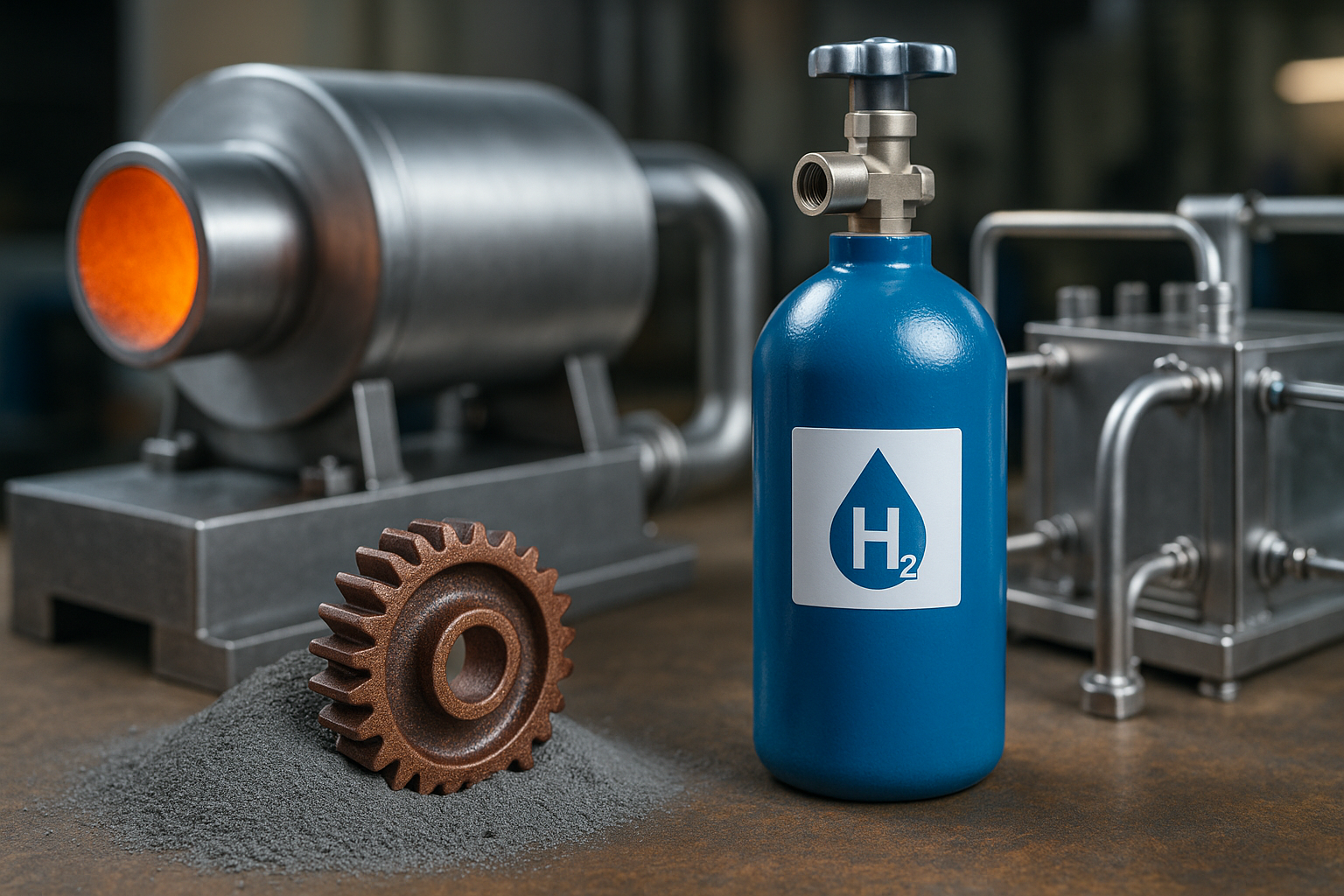
In the world of precision manufacturing, powder metallurgy (PM) is a quiet revolution. From automotive gears to medical implants, PM enables the production of complex metal components with minimal waste and maximum performance. And at the heart of this process, often overlooked, is hydrogen.
The Role of Hydrogen in Powder Metallurgy
Powder metallurgy depends on careful control of material purity, oxidation, and grain structure. Hydrogen is used as a process gas, primarily during sintering, where metal powders are fused at high temperatures. Acting as a reducing atmosphere, hydrogen reacts with metal oxides to prevent or reverse oxidation which is critical for maintaining the mechanical properties of sintered parts.
In addition to sintering, hydrogen is also used in gas atomization, a method to produce fine, spherical metal powders for high-performance applications. Its use ensures defect-free, high-density components, especially in metals such as iron, stainless steel, and titanium.
While nitrogen atmospheres are also common, especially in annealing and certain heat treatments, hydrogen is preferred when higher purity or a reducing environment is required, such as in stainless steel sintering.
Why Manufacturers Choose Hydrogen
The use of hydrogen in PM is driven by more than chemistry, it’s about performance, safety, and cost-efficiency. On-site hydrogen generation using electrolysers allows manufacturers to:
- Ensure a consistent, high-purity supply of hydrogen tailored to the process.
- Eliminate risks and logistics costs associated with storing and transporting compressed hydrogen cylinders.
- Reduce long-term costs by avoiding fluctuating hydrogen market prices and supply chain delays.
In high-throughput manufacturing environments, this control translates to higher yields, fewer defects, and lower downtime.
Use Cases
Hydrogen-based sintering is used to manufacture:
- Automotive parts: gears, sprockets, and clutch plates
- Filtration systems: sintered metal filters for fuel and hydraulic systems
- Medical components: titanium-based implants and dental prosthetics
- Aerospace components: lightweight, high-strength structural parts
Because of its role in near-net-shape manufacturing, hydrogen helps reduce post-processing, machining, and material waste.
Final Word
Hydrogen has long powered the critical stages of powder metallurgy, from maintaining clean sintering atmospheres to enabling high-purity, structurally sound components. As manufacturing priorities shift toward safety, efficiency, and cost control, on-site hydrogen generation is emerging as the preferred solution. At Hydrovolt Energy, we provide scalable, plug-and-play on-site hydrogen systems that eliminate supply chain risks and deliver consistent purity, making hydrogen a smarter, safer, and more future-ready option for modern powder metallurgy.